
Course access
ETB 79 · one-time
 Private Telegram course
English Grammar in Afan Oromo
English for Entrance

Clear curriculum
23 public lesson outlines
Exam focused
Built for practical study
Verified payment
Fulbek confirms access
Private delivery
Telegram delivery verified
About this course
Read the full course overview and topics
About this course
Read the full course overview and topics
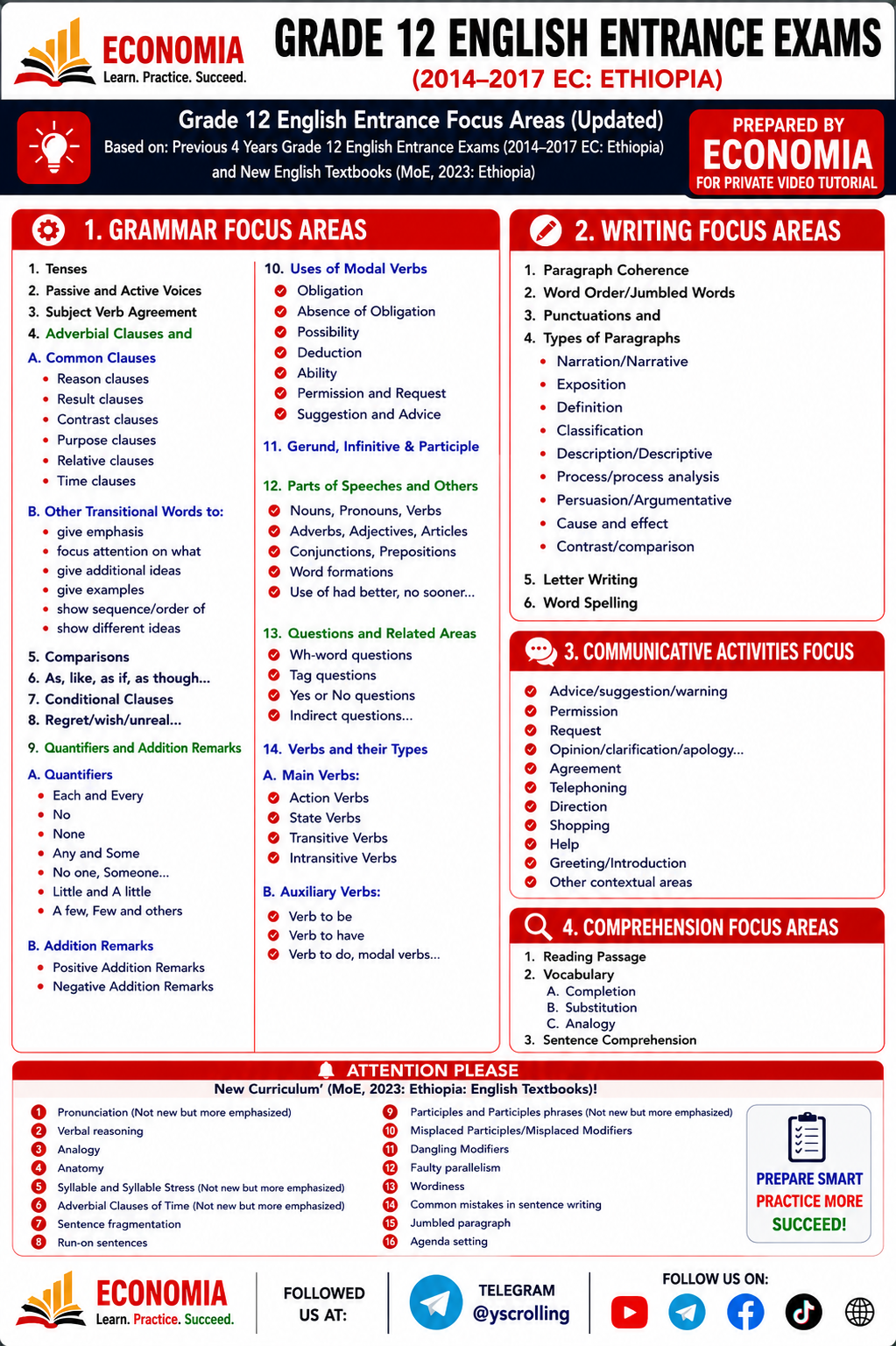
📚 Master English Grammar for Entrance & Class Exams A complete English Grammar course in Afan Oromo, designed to help students understand English grammar easily and prepare confidently for Entrance Exams and Class Exams. The course covers important topics such as Capitalization, Punctuation, Prepositions, Conjunctions, Subject–Verb Agreement, Phrasal Verbs, Spelling Errors, Relative Pronouns, Tenses, Paragraphs, Reading Passages, Modal Verbs, Comparison, Articles, Conditionals, Direct & Indirect Speech, Collocations, WH-Questions, Vocabulary, and more. 🎯 Learn • Understand • Practice • Succeed 📖 Grammar explained simply in Afan Oromo 📝 Focused on exam preparation and practical examples.
Course outline
23 lessonsOpen all lessons, then tap any lesson to preview its outline.
Course outline
23 lessonsOpen all lessons, then tap any lesson to preview its outline.
Full lesson content is delivered inside the verified private Telegram course after enrollment.
1Lesson 1: Capitalization
📚 In this lesson, you will learn: Capitalization for. □ proper nouns □ at the beginning of sentences □ Days and months □ Holidays, festivals, and historical events □ Countries, languages, and nationalities □ Titles of books and newspapers □ Titles of persons □ The pronoun “I” □ Capitalization in quotations □ Names referring to God and deities ✍️Practice questions with answers
2Lesson 2: Punctuation marks
In this lesson, we learn Punctuation Marks in English Grammar with simple explanations and examples. 📚 In this lesson, you will learn: □ Period (.) □Question Mark (?) □Exclamation Mark (!) □Comma (,) □Semicolon (;) □Colon (:) □Apostrophe (') □Quotation Marks (" ") □Hyphen (-) □Uses of each punctuation mark Examples and practice questions ✍️How to punctuate sentences correctly
3Lesson 3: Prepositions
In this lesson, we learn Prepositions in English Grammar with clear explanations, examples, and entrance-exam style questions. This lesson helps students understand how to correctly use common m prepositions in different situations. 📚 In this lesson, you will learn: □ In, at, and on for place and time □ By for transportation and agents □ With for tools and instruments □ Between, among, and except □ Beside and besides □ Reach vs. arrive □ Words that do not take prepositions, such as discuss and reach 🎯 Dependent prepositions Common expressions such as interested in, good at, proud of, afraid of, satisfied with, and looking forward to 🎯Entrance-exam-style multiple-choice questions Detailed explanations for choosing the correct answer
4Lesson 4: Conjunctions
In this part, we study Conjunctions in English and learn how to use them correctly in Ethiopian Entrance Exam questions. 📌 Topics covered: □ Conjunctions of Contrast □ Conjunctions of Reason □ Conjunctions of Result □ Conjunctions of Purpose □ Conjunctions of Manner If, Unless & In Case □ Correlative Conjunctions □ Entrance Exam-style multiple-choice questions Tricky questions with detailed explanations 🎯 Learn the important rules, understand the differences between conjunctions, and improve your ability to choose the correct answer in English Entrance Exam questions.
5Lesson 5: Subject Verb Agreement
In this lesson, we learn the important rules of Subject–Verb Agreement. 📌 Topics covered: □ Singular and plural subjects □ Subjects joined by and □ subject joined by Either...or / Neither...nor / Not only...but also □ Subject joined by as well as / along with / together with □ Here / There sentences □ The + adjective → the rich, the poor, the blind, etc. □ A number of vs. The number of □ Relative clauses and subject–verb agreement □□ Each / Every / Either / Neither / None □ Expressions of time, distance, weight and amount Fractions and percentages Special nouns such as news, physics and mathematics Entrance Exam multiple-choice questions 🎯 Perfect for Grade 9–12 students and university entrance exam preparation. 🗣️ Explanation: English + Afan Oromo 📖 Course: English Grammar for Entrance Exam 🔥 Learn the rules, understand the clues, and solve tricky grammar questions with confidence!
6Lesson 6: Phrasal verb
In this lesson we study some phrasal verbs with their meaning.
7Lesson 7: Spelling Errors
We study some rules and confusing words. □ I before E, except after C □ Drop final “e” before a vowel suffix □ others
8Lesson 8: Relative Pronouns and Relative clauses
In this lesson, we learn Relative Pronouns and Relative Clauses in a simple and exam-focused way. You will learn how to correctly use who, whom, which, that, whose, where, and when, including defining and non-defining relative clauses. 📚 In this video: ✅ Who vs. Whom ✅ Which vs. That ✅ Whose for possession ✅ Where and When ✅ Defining & Non-defining Relative Clauses ✅ Using commas ✅ Omitting relative pronouns ✅ Common exam questions and tricky examples
9Lesson 9: Tag questions and short answers
This lesson explains the rules clearly with simple examples to help you improve your grammar and prepare for exams. 📚 In this lesson: Tag Questions Positive & negative tags Short answers Common patterns and examples Exam-focused practice
10Lesson 10: Quantifiers
■ Quantifiers are words used to show the amount or quantity of something. 🟢 Some 🟢 Any 🟢 Much 🟢 Many 🟢 A lot of 🟢 Few 🟢 A few 🟢 Little 🟢 A little etc
11Lesson 11: Comparisons
as....as ✍️Comparative Degree Parallel Comparatives Progressive Comparatives ✍️Superlative Degree
12Lesson 12: modal verbs
✍️can. ✍️ could ✍️ may ✍️ might be ✍️ had better ✍️ should ✍️ must ✍️ have to ✍️ etc
13Lesson: 13 Articles
Articles ✍️ a ✍️an ✍️The
14Lesson 14: Sentence fragments
Included in the private course
15Lesson 15: words order/ Jumbled Words
Included in the private course
16Lesson 16: Collocations
Included in the private course
17Lesson 17: Wh Questions
Included in the private course
18Lesson 18: All Present tense
Included in the private course
19Lesson 19: All past Tenses
Included in the private course
20Lesson 20: All Future Tenses
Included in the private course
21Lesson: 21 uses of all Present tense
Included in the private course
22Lesson 22: uses of all Past Tenses
Included in the private course
23Lesson: Uses of future tense
Included in the private course